News
Published: Sunday, 9 Nov 2025
The most recent base change to the ICBF Economic Breeding Index (EBI) tells a powerful story of the genetic progress achieved over the last decade. The base cow has been updated from animals born in 2005 to those born in 2015, and in that time the national herd has improved by an impressive €97. The gain in EBI is due to improvements in Milk Sub-Index (€45) and Fertility Sub-Index (€52), highlighting the success of breeding for balance and delivering both productivity and sustainability. This means that since the last base change, cows are delivering almost €200 extra profit per lactation. In order to do a base change, the starting line of ‘Zero’ needs to be reset, so this means that all animals will have their EBI reduced by €97.
What does the EBI base change mean for you?
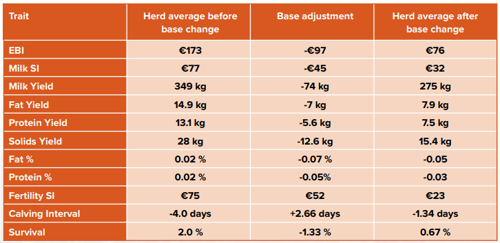
As the base cow has improved by €97, the same amount must be taken off the EBI figures of all animals nationally. So even though the EBI of your animals drops by €97, it does not mean your cows are genetically worse – it simply reflects a new reference point. This means, a cow with an EBI of €173 in the May evaluation, will now have an EBI of €76. She is still the same cow genetically. For example in Table 1, it shows how a EBI herd profile will change due to this base change.
Table 1. Example of how a herd like yours will change after the base change
The changes for you this breeding season:
Because the EBI of all dairy animals has dropped (Table 1), this means that you need to adjust your selection criteria in line with these changes. For example, if you were previously selecting animals with a Fertility Sub-Index (SI) of €40 on the old evaluation, under the new base adjustment these animals will now be –€11 on the updated Fertility Sub-Index (SI). So this means that –€11 becomes your new cut-off if you want to maintain the same standard.
The same principle applies across the individual traits like Milk kg. For example, if you usually target a selection >300kg for Milk yield this target will now be > 226 kg. So, to keep making the best breeding decisions, use the adjustment values provided in Table 1 to update your herd’s selection targets.
New base cow production
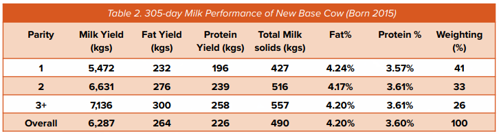
Cows born in 2015 have a higher milk production compared to cows born in 2005. Table 2 presents the breakdown of the 305-day milk performance for the new base cow. The expected yield for a cow with a genetic merit of 0 for milk (kg) is approximately 6,287 kg over a 305-day lactation. Cows with genetic merit values above or below zero will produce correspondingly more or less milk relative to this baseline in an average herd.
It is important to note that most cows do not complete a full 305-day lactation, and actual milk performance relative to genetic potential can vary significantly between herds. Factors such as weather conditions, concentrate feeding levels, grass quality, and overall herd management play a major role in determining production outcomes on farm.
Other improvements to the evaluation
The EBI is constantly evolving to reflect the ever-changing policies and costs in dairy farming. As the value of everything has increased recently, the economic values (EVs) within the EBI were updated by Teagasc to more accurately reflect and predict costs faced by herd-owners in the future. Table 3 includes the price of variables included to estimate the value of individual traits. Also the Health and Management evaluation has been updated for greater accuracy. While these changes impact are generally small some animals will move slightly more or less than the €97 base change. Important to note the overall ranking among animals on EBI will be closely aligned.
Table 3. Price of main variables used to calculate the economic cost of traits in EBI

Maintenance Index
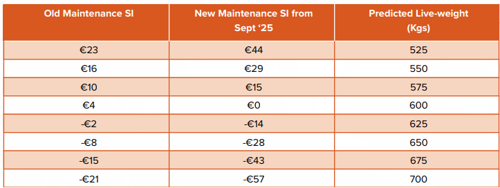
One sub-index often used in bull and dam selection is the Maintenance Sub-Index (SI),which can help you to estimate the average mature weight of cows in your herd. This allows you to breed for uniformity and select animals that suit your system. The key difference now is that the ranges in Maintenance SI have shifted. When selecting bulls and cows, you’ll need to readjust what values best match your herd goals (Table 2).
A useful approach is to identify cows in your herd that you are already happy with and check their new Maintenance SI score. This gives you a reliable guide for setting cut-off values when choosing sires and replacements. See Table 2 for details on what the new Maintenance SI values mean for progeny size. For example, if you usually choose animals with a maintenance of €0 to -€10 in the old evaluation, you now will be selecting animals between -€13 to -€30 on the improved Maintenance SI evaluation.
Table 4. Predicted Live-weight of cows under the old and new Maintenance SI

Figures have change but the rank is the same!
Just like all your dairy animals, Zaki’s EBI figures look a lot different now, but so does everyone else’s. What is important is that he still ranks the same amongst other AI sires. Amongst AI bulls he is still ranked in the top 20% for EBI and Milk SI. He is still an excellent balanced bull, being ranked highly for fertility, and milk solids. The change in Maintenance SI from €7 to -€11 means he is still expected to produce mature cows around 625kg.
Related Articles
Published: 25 Feb 2026
Fertility – A Key Driver of Milk Production

Published: 01 Dec 2025
Selective Dry Cow Therapy - Milk Matters December 2025
Published: 20 Oct 2025
Milk Matters Oct. 25 - Munster Bovine's Herd Health Programme
Published: 07 Aug 2025
Milk Recording - Milk Matters July 2025