News
Published: Monday, 20 Oct 2025
Munster Bovine’s Herd Health programme began in 2010. Alongside the bulk milk disease screening, the option to have a face to face meeting with a Munster vet has always been available. Today, close to 3000 herdowners across Munster avail of the programme, with 1100 choosing the gold programme with consists of a face to face meeting with a Munster affiliated vet. Dairygold have always seen the value of herd health as being integral to farm profitability and overall sustainability. The fact that Herd Health is one of the seven pillars of the Grassroots sustainability bonus is a clear reflection of this. Two of Munster Bovine’s other core services are part of two other pillars, namely milk recording and improving genetics, both dairy and dairy beef. Hopefully those of you who have availed of the one to one meeting will be familiar with what is covered and have found it beneficial over the years. Below is a brief explainer of the programme and what is involved.
There are three tiers to our Herd Health programme – Bronze, Silver and Gold programmes.
Gold Programme:
· Bulk milk disease screening four times a year.
· Phone consultation support from the Munster Bovines vets, which herdowners can avail of whenever necessary.
· A one-on-one consultation with a Munster Bovine affiliated vet at the end of the year.
· The cost of this programme is €399 per herd.
Silver Programme:
· Bulk milk disease screening four times a year.
· Phone consultation support from the Munster Bovines vets, which herdowners can avail of whenever necessary.
· A one-on-one phone consultation with a Munster Bovine affiliated vet at the end of the year.
· The cost of this programme is €330 per herd.
Bronze Programme:
· Bulk milk disease screening four times a year.
· Results are posted to the herd owner and made available on FarmOps.
· The cost of this programme is €280 per herd.
Bulk Milk and Disease Screening.
Four samples of milk are taken from your bulk tank at different times throughout the year by the truck driver when the milk is being collected. This makes it a very simple and convenient way of monitoring the disease status in your herd. After each round of testing, the results are posted or emailed to the herd owner or if customers are using the Munster Bovine FarmOps app they can view their most recent herd health results within the Herd Health module of the app. All previous herd health test results are also displayed in the FarmOps App.
If you give us permission, the results are also emailed to your vet.
The following is the diseas testing schedule for 2025:
| Disease | Apr test | Jun test | Aug test | Nov test |
|---|---|---|---|---|
| IBR | ||||
| BVD (BVDp80) | ||||
| Lepto | ||||
| Neospora | ||||
| Liver Fluke | ||||
| Salmonella | ||||
| Stomach worms | ||||
| Mycoplasma bovis | ||||
| Digital Dermatitis |
Herds that are availing of the Gold programme have a one-on-one meeting with a Munster Bovine affiliated vet at the end of the year during which they will have an opportunity to address any issues they may be having on the farm. Other topics that are covered include:
Nutrition:
Nutrition in early lactation has a major knock-on effect on both milk production for the year and fertility performance. Cows in early lactation have a limited capacity to intake feed, only reaching their peak feed intake 50-70 days after calving. As a result of this, cows in early lactation will suffer some degree of negative energy balance (NEB). NEB that is severe or prolonged results in excessive BCS loss in early lactation which will result in impaired fertility performance, extending the time it takes for these animals to go back in calf. During the consultation, the vet will have access to a nutrition report which uses milk production and milk constituent data from milk recordings. The nutrition reports from early milk recordings can reveal issues with energy balance at this time.
Fertility:
The Fertility report that is available to the vets during the consultation provides key data to assess herd reproductive performance including:
· Length and pattern of the calving season
· Six week calving rate
· Submission rate
· Non return rate
· Repeat intervals – which allow heat detection efficiency and accuracy to be analysed.
· Calf mortality
· Replacement rate This information aids in identifying any issues around reproductive performance.
Somatic Cell Count (SCC):
The herd health consultation is a great opportunity to closely examine the wealth of SCC information that will be available to milk recording herds. Single SCC results are useful for managing the bulk tank cell count and identifying cows that may need further examination (eg. using a CMT test), but the real value comes from looking at SCC trends over time.
By assessing individual cow SCC trends for the year, as well as for the previous lactation, vets can:
· Identify chronically infected cows, with little chance of a cure.
· Recommend targeted dry period management, such as extended dry periods or long-acting dry cow therapy.
· Detect issues with cows picking up infection over the dry period, prompting discussions around dry off procedures, hygiene and space in the dry cow house.
Breeding Decisions:
The Lifetime Summary report ranks cows based on their profitability. It does this by calculating a margin per day for each cow, taking into account both her milk production but also the cost of producing this milk. Costs vary according to the production level of the cows, the length of the dry period and the calving date.
Cows are then classified into:
· Top 20% - most profitable cows (highlighted in green)
· Middle 60%
· Bottom 20% - least profitable cows (highlighted in red)
This report can inform decisions around culling, as not only are your least profitable cows colour coded in red, but their lactation SCC status is also included in the report.
Economic Breeding Index (EBI):
The EBI report provides a single profit-based value for a dairy cow or bull, indicating their genetic potential to generate profit on a farm. A higher EBI values indicate
greater genetic potential for profitability. But what is arguably more important is how this figure is broken down into each of the 8 sub-indexes. By examining these sub-indexes herdowners can align breeding goals with herd strategy. Maybe you would like your herd to produce more solids or maybe the genetic potential for production is good, but fertility could be improved.
Vaccination planning and dosing protocols:
Using the results of the bulk milk tests, a vaccination protocol can be tailored to your farm. Each herd will receive a vaccine planner completed by the vet specifically for your herd.
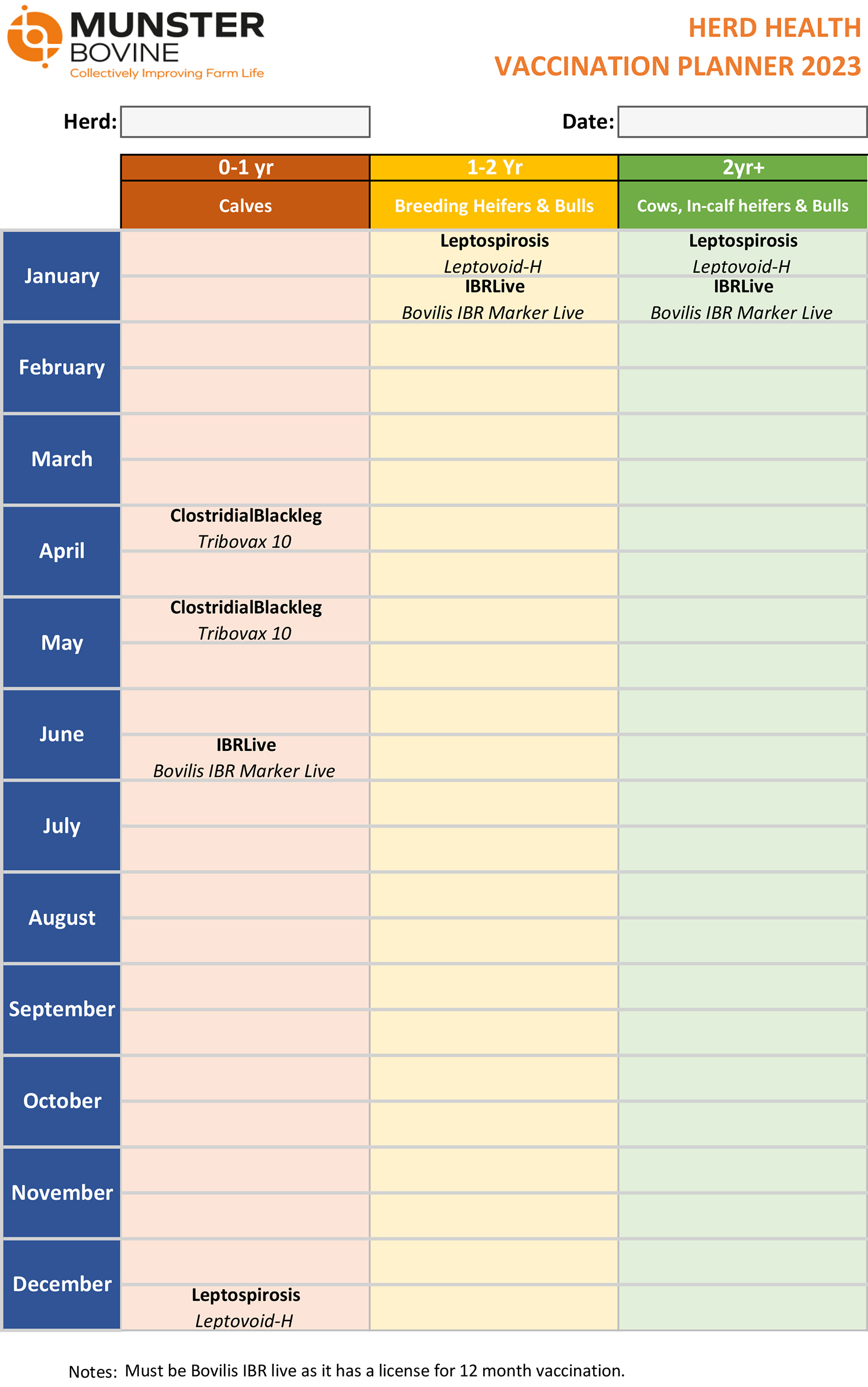
Bulk milk test results may also be used to plan parasite control strategies. Liverfluke antibody levels are tested four times a year and stomach worm antibody levels are tested three times a year. Using these results the vets can advise a winter dosing strategy that will best suit your farm. If high levels of antibodies to Liverfluke persist from the Autumn, through to the first test in the Spring, despite dosing during the dry period, this may be an indication of anthelminthic resistance to the product used.
End Goal - Improving overall herd performance and health.
The main aim of the herd health consultation is to evaluate whether a herd is realising it’s potential within the farm system and to identify areas for improvement. Using all the above information we can compare the herd’s current performance against the it’s potential based on the genetics of the herd and the farm system.
Contact our team on 022 43228 for more information on the Herd Health Programme.
Related Articles
Published: 25 Feb 2026
Fertility – A Key Driver of Milk Production

Published: 01 Dec 2025
Selective Dry Cow Therapy - Milk Matters December 2025
Published: 09 Nov 2025
NEW BASE REVEALS A DECADE OF GENETIC PROGRESS - Milk Matters November 2025
Published: 07 Aug 2025
Milk Recording - Milk Matters July 2025