News
Published: Monday, 5 Jan 2026
Munster Bovine’s most recent webinar Healthy Dry Period, Strong Spring: Nutrition & Winter Health Essentials focused on dosing dos and don’ts, winter vaccination and managing cows in the dry period to set them up for a successful 2026 lactation and breeding season.
Parasite Control
From the 1st of December 2025, all anti-parasitic drugs have become prescription only medicines. This means that herdowners will require a veterinary prescription to buy these products.
This new legislation has been introduced to address the growing issue of anthelmintic resistance on Irish farms. Anthelmintic resistance is when a parasite can survive and tolerate a normally effective dose of an anti-parasitic drug.
The challenge - How do we effectively control parasites without contributing to anthelmintic resistance?
Control Parasites:
• Choose treatments that are effective and administer these correctly - this will maintain animal performance and avoid any health issues due to parasitic disease.
• Pasture management – reduce the need for dosing, especially in calves, by using low risk pasture such as newly reseeded ground or aftergrass.
Slow the Development of Anthelmintic Resistance:
• Avoid underdosing – a good rule of thumb is to dose according to the heaviest animal in the group.
• Avoid over-reliance on a particular anthelmintic, rotate products where possible.
• Allow animals to develop an immunity to parasites by allowing some exposure.
• Avoid unnecessary treatments – only treat when necessary.
• Instead of blanket dosing a particular group of animals only dose those that are underperforming. This is known as selective dosing. Interestingly, a poll carried out during the webinar showed that 75% of those tuned in still blanket dose their cows for worms during the dry period.
• Refugia - maintaining a population of parasites on your farm that are susceptible to anthelmintics. These susceptible parasites will mix with the resistant parasites thus diluting the resistant genes. This can be achieved by selective dosing and by not dosing animals and moving them immediately, instead allow them to graze the contaminated pasture again after dosing to pick up some of the susceptible worms.
More Monitoring, Less Dosing!
If we are to reduce our use of anthelmintics, without impacting on animal performance, we must have a system in place to monitor the risk of parasitic disease.
• Animal performance – reduced milk production, decreased weight gain, ill thrift
• Clinical signs – coughing, diarrhoea, oedema (eg bottle jaw)
• Diagnostic tests such as faecal egg counts (FECs), bulk milk testing, post-mortem results and abattoir reports.
Figure 1:
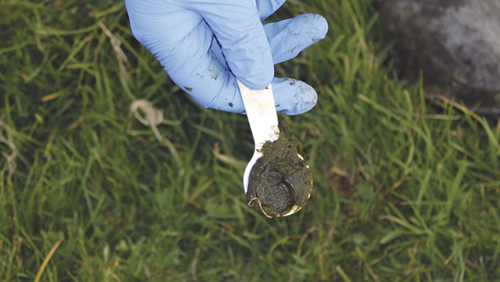
As part of the Munster Bovine Herd Health Programme, bulk milk samples are tested regularly throughout the year for both liverfluke and stomach worms. This bulk milk liverfluke test is very sensitive and accurate and, by testing for liverfluke before the dry period and again after, we can assess the effectiveness of any dosing.
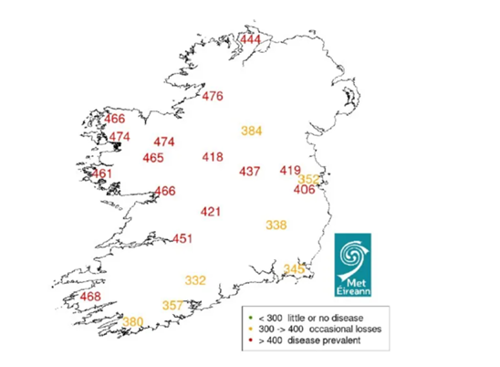
• Climate and local knowledge – the Department of Agriculture, in collaboration with Met Éireann, UCD, Teagasc and Animal Health Ireland, publish a Liver Fluke Forecast each year which advises farmers of the predicted risk of disease caused by liver fluke infection in livestock for the following winter.
Figure 2:
Winter Vaccinations
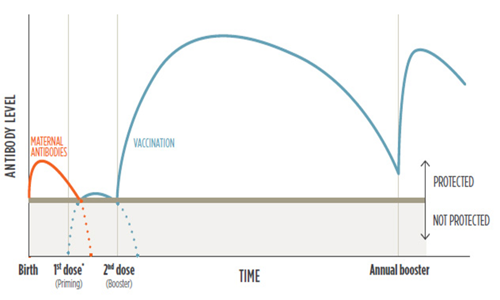
Traditionally, vaccines such as Lepto and IBR were given before the breeding season, at a time when farms were busy milking cows and rearing calves. However, there is a strong case for carrying out some of these vaccinations in the winter. Often, in spring calving herds, the cows will be dry so there will be more time on the farm for these jobs. Cows are under less pressure at this time of the year so will potentially mount a stronger immune response. These vaccines can be done at the same time as other jobs such as dosing or tail clipping and young stock are also housed at this time making whole herd vaccination easier.
Tips for Successful Vaccination:
• Maintain the cold chain – vaccines should be refrigerated as soon as possible after purchase.
• Use the correct dose rate and administer correctly e.g. under the skin, into the muscle. Make sure to use a sterile needle.
• Allow 2 weeks between different vaccines unless advised otherwise by your vet.
• Follow the vaccination protocol carefully.
Figure 3:
Dry Cow Nutrition
Correctly managing cows in the dry period will set the herd up for a successful lactation and breeding season.
Two main areas to focus on during the dry period are body condition score (BCS) and mineral status of the herd.
BCS:
Figure 4 below shows BCS targets at different times.
Figure 4:
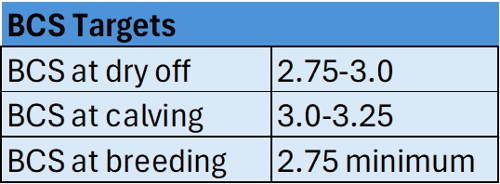
90% of the herd should meet these targets.
If cows are over conditioned at calving it predisposes them to negative energy balance around calving and in turn to production diseases such as milk fever, ketosis, retained afterbirths and displaced abomasums. This negative energy balance also delays the return to heat in affected cows.
Equally if cows are underconditioned this can lead to reduced immune function, again increasing incidence of disease.
Tips for Managing BCS:
• BCS all cows at dry off, group and feed accordingly – if you are not comfortable doing this it is worthwhile taking the time to learn. One poll in the webinar asked ‘Do you feel that you can body condition score your cows reasonably accurately? 71% answered yes and 29% answered no to this question.
• Test your silage – only 62% of those tuned into our webinar test their dry cow silage.
• Avoid group stress precalving.
• Avoid the use of night feeding only.
Mineral Status
Milk fever or hypocalcaemia is a common health event seen on Irish dairy farms. We are all familiar with the classic milk fever case of a cow down, usually within 24 hours of calving, but the effects subclinical milk fever can also have a major impact on herds.
The two main effects of either clinical or subclinical milk fever on the health of an animal are:
1. Reduced smooth muscle function:
This reduction in smooth muscle function has several negative effects on key muscular functions of the cow:
• Reduced rumen and GIT motility – this causes a decrease in feed intake which in turns leads to negative energy balance, displaced abomasums and decreased production.
• Decreased uterine motility leading to dystocia and retained foetal membranes.
• Decreased teat sphincter muscle contractions leading to increased incidence of mastitis.
2. Decreased immune function:
• Increased incidence of retained foetal membranes
• Increased incidence of metritis
• Increased incidence of mastitis
Controlling either clinical or subclinical milk fever involves a complex interplay of hormones and minerals – see figure 5 below.
Figure 5:
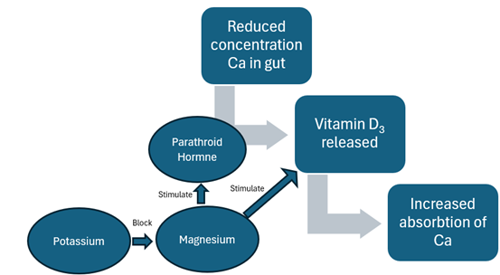
Potassium (K) blocks the absorption of magnesium and magnesium is crucial for calcium mobilisation. If dry cow silage is high in K, the diet will have to be managed accordingly to counteract its effect on magnesium. This again shows the importance of testing the dry cow silage and if the levels of K are high, seek advice around managing this.
Our webinar ‘Healthy Dry Period, Strong Spring: Nutrition & Winter Health Essentials’ goes into more detail on this. Scan the QR code below to watch this webinar.

Related Articles
Published: 25 Feb 2026
Fertility – A Key Driver of Milk Production
Published: 26 Jan 2026
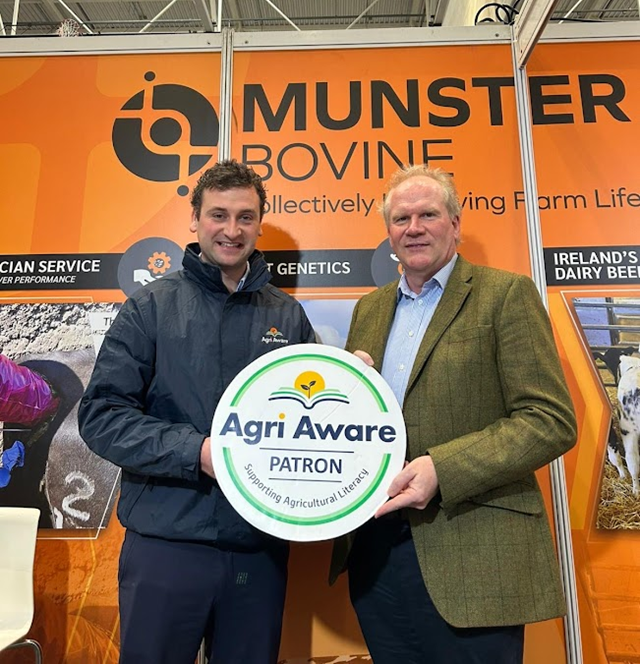
Munster Bovine the latest to come on board as a patron of Agri Aware
Published: 01 Dec 2025
Selective Dry Cow Therapy - Milk Matters December 2025
Published: 09 Nov 2025
NEW BASE REVEALS A DECADE OF GENETIC PROGRESS - Milk Matters November 2025