News
Published: Wednesday, 25 Feb 2026
By Alan Twomey & Fíona Dunne
Since the introduction of the Economic Breeding Index (EBI), the fertility of Irish dairy cows has improved dramatically. This was clear in the most recent base change, which showed that the fertility sub-index increased by €52 between 2005 and 2015. This progress has played a major role in improving the efficiency of Ireland’s seasonal, grass-based dairy systems, allowing farmers to maximise milk production from grazed grass.
Despite this improvement, there is increasing discussion within the industry that more emphasis should now be placed on milk production, as fertility is perceived by some to be “fixed”. While fertility has undoubtedly improved, it remains a critical component of dairy breeding, particularly in grass-based systems where compact calving is essential to control costs and maximise milk output. Fertility should therefore remain a key focus in breeding decisions.
Current Fertility Performance on Irish Farms
Although fertility is often taken for granted in many herds, ICBF statistics highlight a wide range in fertility performance across Irish dairy farms. As shown in Table 1, when the average herd is compared with the top 10%, significant scope remains to further improve fertility. Herds in the top 10% are achieving calving intervals 11 days shorter, a six-week calving rate 20 percentage points higher, and cows lasting almost one additional lactation in comparison to the average herd. These differences have major implications for both herd milk production and overall profitability.
Table 1. Fertility performance indicators in Irish Dairy herds in 2025 (ICBF)

Fertility Within the EBI
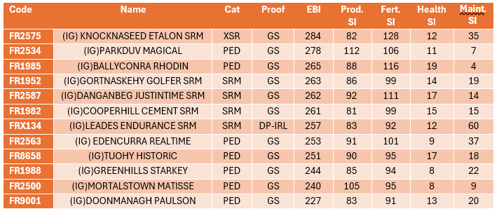
The EBI places a strong emphasis on fertility, with 24% of the overall emphasis. The fertility sub-index is made up of two key traits: Calving interval and Survival. The objective of this sub-index is to shorten the calving interval and improve cow longevity. Animals with a high fertility sub-index have been shown to be easier to get back in calf and to last longer in the herd. Continued genetic selection for fertility is therefore essential to sustain progress and avoid regression in herd performance. As a result of 25 years of selection there are now sires available that are good for both milk production and fertility, which means that farmers do not have to compromise one to improve the other. In Table 2 is a selection of sires that are balance for both milk production and fertility traits.
Table 2. Sample of sires available from Munster Bovine that are ranked highly on fertility and milk production traits
Improving Fertility Improves Milk Production
When it comes to breeding decisions, there is often a strong focus on milk traits such as milk solids yield and percentages. While these traits are important, improving fertility frequently has a greater overall impact on herd milk production than selection for production alone.
In Ireland’s seasonal, grass-based system, calving interval is critical to achieving a compact calving pattern that maximises the utilisation of grazed grass. It also plays a key role in extending lactation length, as most herds do not milk during the winter period.
For example, consider a herd producing 6,500 litres per cow with 4.6% fat and 3.8% protein. If calving interval is reduced by 10 days, tightening the calving pattern and increasing average lactation length by 10 days, this results in approximately 11 kg of additional milk solids per cow. In a 100-cow herd, this equates to an extra 1,100 kg of milk solids, which is equivalent to carrying two additional cows producing 550 kg of milk solids each, without increasing cow numbers.
One of the biggest drivers of milk production within a herd is cow survival and herd maturity. Over recent years, many herds expanded rapidly, resulting in high replacement rates and younger herd profiles. As herd sizes have now stabilised, it is vital that farmers focus on getting the most production from their existing cows by improving longevity.
Data from Munster Bovine milk-recording herds shows that:
- First-lactation cows produce only 75% of mature cow milk solids
- Second-lactation cows produce 89% of mature cow output
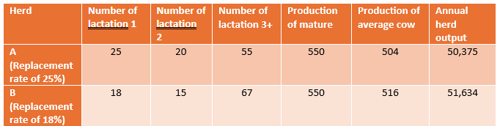
In a herd where mature cows produce 550 kg of milk solids, this equates to 413 kg for first-lactation cows and 490 kg for second-lactation cows
Table 3 illustrates the difference between two herds where mature cows produce 550 kg of milk solids, but replacement rates differ. Herd A has a higher replacement rate and a younger age profile, resulting in lower overall production. Herd B, with a replacement rate of 18%, has more mature cows and produces an additional 1,259 kg of milk solids, despite identical mature cow performance and the same number of cows.
Table 3. Difference in herd milk production with a lower replacement rate
Breeding for 2026 and beyond
Fertility is not a trait that can be considered “fixed” or deprioritised. It remains a fundamental driver of milk production, particularly in seasonal, grass-based dairy systems. By continuing to improve calving interval and survival, farmers can increase lactation length, improve herd maturity, reduce replacement costs and maximise lifetime milk solids production.
Therefore, for breeding 2026, farmers need to ensure they continue to select sires balanced on EBI which are good for both milk production and fertility. The continual improvement in these two sub-indexes will lead to higher profitability at farm level.
Related Articles
Published: 01 Dec 2025
Selective Dry Cow Therapy - Milk Matters December 2025
Published: 09 Nov 2025
NEW BASE REVEALS A DECADE OF GENETIC PROGRESS - Milk Matters November 2025
Published: 20 Oct 2025
Milk Matters Oct. 25 - Munster Bovine's Herd Health Programme
Published: 07 Aug 2025
Milk Recording - Milk Matters July 2025